Game 13 - State of the offense
The Mariners offense isn’t hopeless, but too many whiffs undermine their ability to breakthrough.
It was another sluggish, frustrating, and bad offensive performance for most of the series finale in Toronto. The Mariners struck out 13 times in the first nine innings and managed just one run on three hits. They were fortunate to push the game into extras on the back of another dominant outing by Logan Gilbert (and some clutch defense).
That’s when we got something we haven’t seen much this year. A leadoff homer, a pair of walks, a double, a single—a good ol’ fashioned rally. In the blink of an eye, the game was 6-1 and beyond reach.
Scott Servais called it a big win for the team.
“Putting an ending together like that in the 10th inning was great,” he said. “That’s what we’re capable of doing.”
In broad strokes, he’s right. The Mariners are capable. In fact, they’ve shown us they’re capable already this year. There are several underlying metrics from the first two weeks that suggest the potential for a good or even great offense in 2024.
But the Mariners strikeout rate is a league worst 29%. They have an 80 wRC+ and a -15.9 wRAA. Put another way, the Mariners were the final team in MLB to score six runs in a game, and even that required an assist from the Manfred Man.
Something isn’t working.
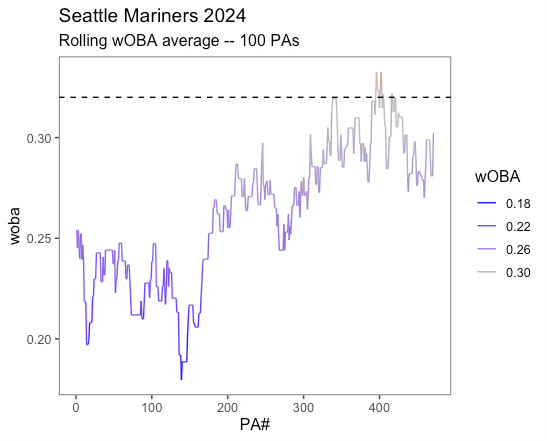
The “green” zone
Jerry Dipoto said the other day he thinks the team is putting together some quality at bats, which hasn’t been the case when they’ve struggled in years past.
“They haven't come out of their approach,” Dipoto said. “We’re swinging at the right pitches [and] we’re grinding through at-bats.”
He seems to be correct.
It’s best to think of the zone in four regions—heart, shadow, chase, and waste. Batters should focus most of their swings in the heart region, and they should never swing at pitches in the chase or waste regions. The shadow region is a bit trickier, but for the most part, batters should avoid those pitches if they can help it.

This zoned approach is the basis of the Mariners in-house scoring system for offense, called the “Rake” score. Aaron Goldsmith gave us a glimpse of what that might look like in a recent interview. Basically, the system defines a “green” box where the pitcher is particularly vulnerable, and batters are instructed to hunt pitches within that box. If a batter swings at a pitch outside the box, that pitch should be in a location where the batter typically makes good contact.
I don’t have an exact match for this system yet, but I do have a simplified tool that provides a general sense for whether a player or team is swinging at hittable pitches. I call it the Heart Swing Index. This looks at the ratio of swings committed to the heart zone—i.e., heart swings as a percentage of total swings—and weighs it by the rate of heart pitches seen.
The Mariners to this point are seventh in MLB with 42% of their swings committed to the heart region. After layering in the number of heart pitches seen, they still rank in the top third. They’ve also swung at the fifth fewest shadow pitches in MLB.
The Mariners approach isn’t perfect and there’s a bit more nuance related to pitch type and the count. But the strikeouts and general offensive woes don’t seem to be the result of batters wildly chasing out of the zone slider after slider after slider.
Brant Brown talked this offseason about the benefit of this approach in “getting to the slug.” Batters should work to eliminate pitches and zones, and force the pitcher into the heart of the plate. That’s when a team can do damage.
“Slug is thrown, not hit,” Brown said.
It seems to be working. The Mariners hard hit rate is 41%, and their hard-er hit rate (BIP >= 100 mph) is 25%. Both rank top 10 in MLB. They also have the second best sweet spot rate at 40%, and the fifth best overall launch angle quality. Their .391 xwOBAcon ranks seventh in MLB.
But the Mariners aren’t being rewarded for their high quality contact—expected results exceed actual results by more than 50 wOBA points.
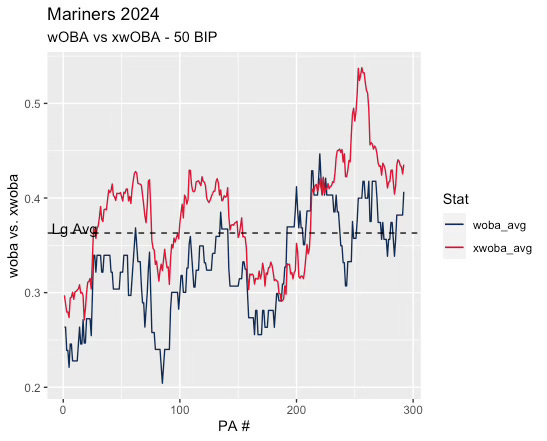
They also seem to be the victim of poor sequencing. This year, 19.8% of their base runners have come with two outs and nobody on. Not only is that the most in MLB, it’s the most in a season in the pitch tracking era. Base runners lead to pressure lead to mistakes lead to more base runners lead to runs (a good ol’ fashioned rally). It’s hard for that cycle to play out when it starts with two outs.
The catch
OK so the Mariners are generally swinging at the right pitches and making good contact, but they aren’t getting positive results. Is this as simple as Good Team, Bad Luck?
Well, no.
The Mariners are whiffing a ton. Their 28% whiff rate is fourth highest in MLB, and they’re in the bottom third for converting heart pitches into balls in play. It’s one thing to force a pitcher into the zone, it’s another to punish those pitches, but it’s another still to consistently punish those pitches. The Mariners just aren’t making enough contact right now, exposing themselves to an elevated strikeout rate and the cruel realities of BABIP and cluster luck.
Mitch Haniger shared his thoughts in a recent interview with Shannon Drayer.
“I can’t speak to what each individual feels but … to me it just seems most guys aren’t picking the ball up well or they’re in between or they’re trying to cover too many pitches, which leads to swing and miss and chase.”
It seems like the team is working to implement this approach of hunting zones and laying off the close stuff. And we see that play out in the data. But they’re clearly not comfortable in the new system yet, and that’s led to whiffs, bad counts, zone expansion, and more whiffs. It’s like there’s 90% of a good approach here that collapses without the final 10%.
The positive spin is that all this is somewhat encouraging. The Mariner are doing a lot of things well, and their biggest issue is something that should improve with time and reps—it’s early, as they say.
The not-so-positive spin is that the Mariners are likely to struggle until they figure out how to make more contact. Their ambitions for 2024 are limited by how long it takes to adjust.