Game 19 - A near-flawless approach
Mariners batters showed the best approach of any team in any game in MLB this year.
The Mariners completed a sweep of the Reds on Wednesday in an all around dominant performance. They scored five more runs, bringing their total to 17 for the series, or just under six per game—double what they’ve scored in the rest of year.
Prior to the series with Cincinnati, I’d maintained the Mariners offense looked OK. They had generally swung at good pitches, made quality contact, and just weren’t getting the box score results. Sure, the whiff rate was too high, leading to the most strikeouts in MLB. But they didn’t look like a true bottom five offense.
In fact, after the first two games against the Reds, my initial reaction was that Mariners had (in some ways) played worse in the series despite scoring more runs. You can kind of see that reflected in the wOBA vs xwOBA chart.
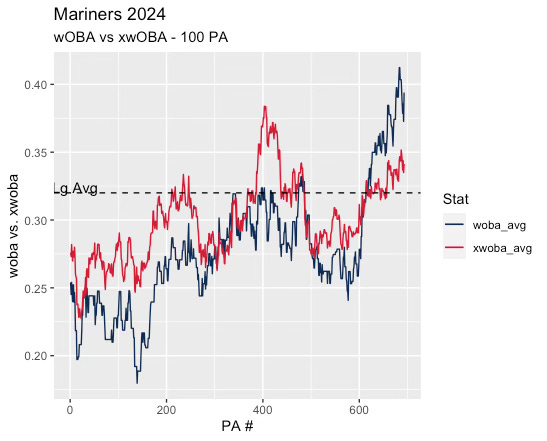
Each series is a little more than 100 plate appearances.
But that changed Wednesday when the Mariners displayed their best approach of 2024 and maybe of any game in the Dipoto era.
From a performance perspective, the zone is split into four regions—heart, shadow, chase, and waste. Mariners batters are instructed to hunt pitches in the heart of the plate and to layoff pitches elsewhere.1 The way I evaluate this approach is with a tool called the Heart Swing Index. It takes the ratio of swings committed to the heart zone—i.e., heart swings as a percentage of total swings—and weighs it by the rate of heart pitches seen.

Of the Mariners 59 total swings on Wednesday, 33 were at pitches over the heart of the plate. That’s a heart swing ratio of 55.9%, which ranks sixth highest in MLB this season. However, the Mariners saw only 26.9% of pitches in the heart region, meaning their relative commitment to those pitches on Wednesday is unmatched.2
In addition, Mariners batters swung at just two of the 59 pitches they saw in the chase and waste regions—3.4% is the lowest rate in MLB this year. They also swung at just 41.4% of pitches in the shadow region, which ranks in the top 5%.
Here’s what that approach looked like:
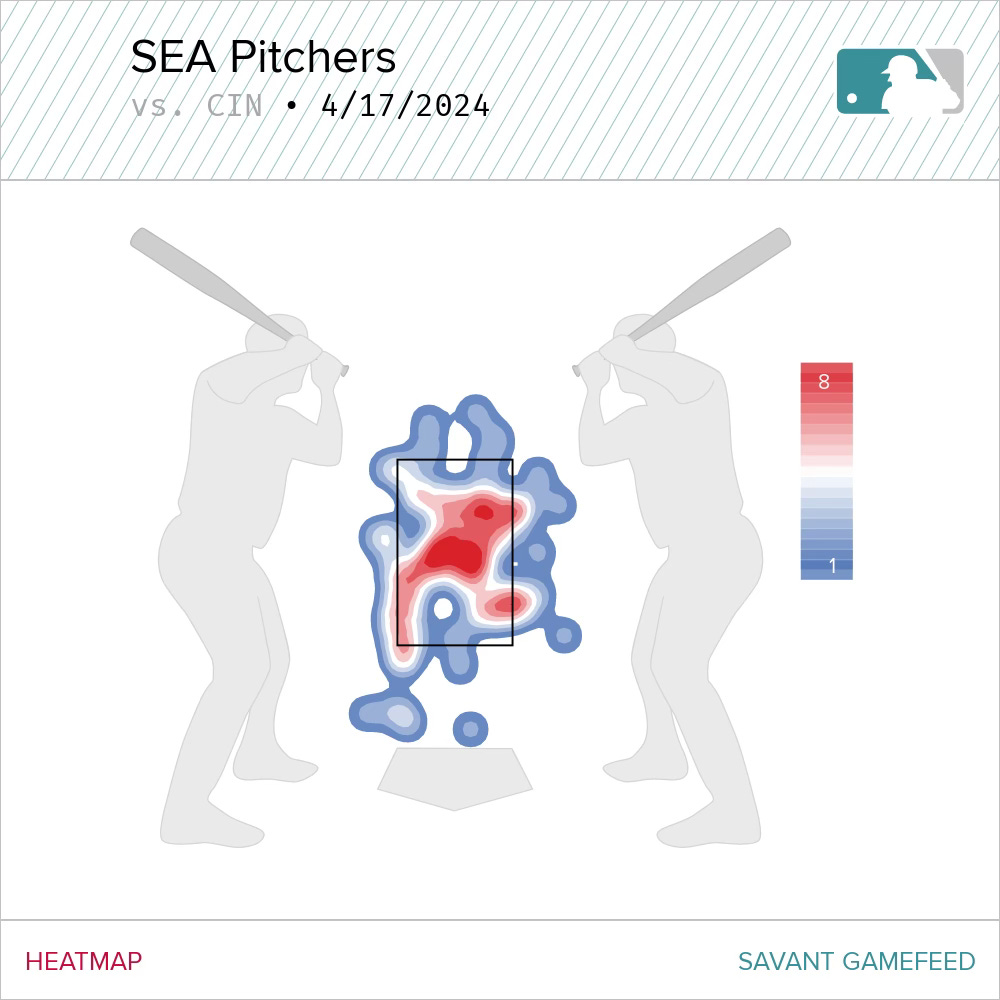
The game is a good illustration of the collective approach the Mariners have been pushing this year. Six batters posted swing decision scores in the top 10% of individual player games; a seventh batter was just outside in the top 15%. They drew a total of seven walks and created constant traffic on the bases. When they did swing, they made high quality contact with a 40% hard hit rate and .488 xwOBAcon.
Mitch Garver outlined this collective approach with Shannon Drayer in Spring Training. A good offense doesn’t give in to pitchers, he said, and instead turns the dynamic of the plate appearance against them.
“The whole idea is to create a nine-on-one approach. Nine of our guys against the guy that’s on the mound,” Garver said in March. “We’re trying to wear him down to get him off his game plan and get on our game plan.
“How do you separate your offense from other teams offenses? Well, you don’t chase those pitches or you don’t pop up the high fastball. You get on top of it and you hit a line drive pull-side. You are taking away the pitcher’s best pitch. Stuff like that is what separates teams, and it’s what keeps the needle moving for the next guy in the lineup. And as soon as you get traffic on the bases and the pitcher realizes he might not have his good stuff tonight, you got him. He flips the script. He starts relying on other pitches. And that’s when the slug comes in.”
Make the pitcher work; eliminate his best pitch; get him under pressure; force him over the plate; do damage. It’s simple, effective, and exactly what the Mariners did Wednesday.
Again, the Mariners this year have done an overall decent job implementing this approach. Their heart swing index and xwOBAcon are both top 10 in MLB on the season. But there’s still a level of inconsistency game-to-game, batter-to-batter that’s limited the overall effect.
Aaron Goldsmith touched on that earlier this month.3
“My sense is that there are maybe three, maybe four, or maybe some days two guys who are taking that plan of action and implementing it. And it can’t be two doing it and seven not. It needs to be the vast majority, if not hopefully all nine.”
Still, it’s early, as they say. The Mariners have shown plenty of positive signs on offense, and they’re starting to see results. The next stop on the road trip is the moon, and it’s an opportunity to continue building momentum at the plate. I’ve said several times this season that I don’t doubt the Mariners offense will breakthrough at some point. It’s just a matter of how long it takes them to find that consistency.
The team has layered in a bit more nuance related to the count, pitch type, and situation. I’m working on a system to better capture their in-house approach score.
Heart Swing Index == 2.1; Z-score == 3.42
Goldsmith may not be an official source within Mariners baseball operations, but he is generally plugged into that sphere.