Game 25 - Mariners control the AL West
The Mariners did not play particularly well against the Rangers on Thursday, but the series win counts all the same.
The Mariners won 4-3 in the series finale in Texas. They’ve now won seven of their last nine and lead the AL West by a half game over the Rangers and six-and-a-half games over the last place Astros.
But the Mariners did not hit well on Thursday. They swung at almost half the pitches they saw out of the zone, and their heart swing index ranked in the bottom 5% of all team games in MLB this year. They struck out 11 times and didn’t draw a single walk. In fact, they did not have a single base runner after the fifth inning.
Their team wRC+ fell below average, and they reclaimed the top spot on the MLB strikeout leaderboard.
The one thing the Mariners did do well on Thursday was hit a pair of timely home runs.
The first came from Ty France in the top of the first. He turned around a fastball and drove it 101 mph into the right field seats. It was his first home run of the season and, the first since his swing overhaul.
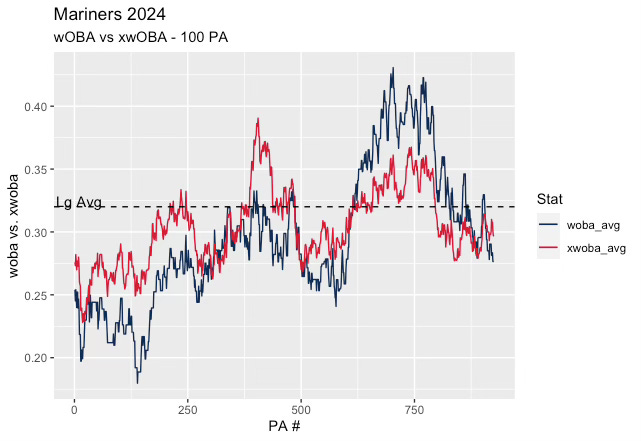
I’m often a bit skeptical of the Driveline swing changers. I certainly respect the willingness to get better, and Driveline seems like a great place to do so. But it’s the modern twist on the “Best Shape Of My Life” narrative that we’ve heard for decades. Still, there might be something to it for France. By the underlying metrics, France has been the Mariners best regular hitter. He’s made good swing decisions, and he’s hit the ball hard and at good angles with a 50% hard hit rate, 47.5%(!!!) sweet spot rate, and .425 xwOBAcon. He hasn’t combined them often enough with just a 5.7% barrel rate, and he’s still whiffing a tad too much. But overall I’m more inclined to believe his .354 xwOBA than his .305 wOBA. It seems like for France this year it’ll be a matter of consistency and staying healthy (crucially, he’s yet to be hit by a pitch).
The second timely home run came from Luis Urías who caught a heart fastball in the fifth and hit a 103 mph, two-run homer into the seats in left. It was Urias’ second of the year, and all five of his hits so far have been for extra bases. His season wRC+ is up to 136 (despite striking out nearly 40% of the time).
One player who struggled (again) was Mitch Garver. He’s now hitless in his last 17 plate appearances with seven strikeouts. I assume he’ll figure it out by the summer, if not sooner, but it’s undeniably been a slow start for him. I’ll buy a bit into the narrative that he’s still settling in. He talked on Tuesday after getting his World Series ring about the opportunity to finally turn the page.
“I didn’t have a chance to really celebrate a World Series because when the parade was over, I was a free agent and I was looking for a job,” Garver said. “We ended up signing with Seattle, and we bought a house, we had a baby and like all these things happened so quickly. And now I have a chance to get the ring and it’ll be a good opportunity to relive what we were able to accomplish, but also move on.”
Everyone else is dealing with things, too, of course. France just had a kid, and Cal Raleigh basically won Tuesday’s game for the Mariners with an exploded tooth or something. But Garver is in a new place with a new family learning a new system and playing (technically) a new position—it’s not unrealistic to think there could be some downward effect on performance.
On the other hand, Garver is now 33—the age where swing speeds start to rapidly decline. And he’s also now making poor swing decisions. He ranks in the bottom 20% of the league by my heart swing index, which is a sharp divergence from his historically excellent approach. Colin O’Keefe thoughtfully pointed out on Friday that the two could be related.
… if your swing is slow and/or inefficient—or just a tick slower than it used to be—the time you have to recognize a pitch before you gear up to swing is reduced. Every millisecond earlier you have to swing is a millisecond you didn’t have to evaluate whether or not you even should.
We don’t know if that’s the case for him yet since full data isn’t publicly available, but it’s something to consider. I also wonder if he’s still dealing with back issues that sidelined him in the first series. We’ll see what adjustments he makes in May. I’m still more likely for now to believe he’s the career 125ish wRC+ guy than the 55 wRC+ he’s posted this year.
Luis Castillo pitched just OK. His velocity was up, and his stuff looked good, generating a 36% whiff rate. In fact, he now leads MLB in total whiffs. But as has been the case with Castillo at times this year, he struggled to put Rangers batters away after working ahead in counts. To their credit, the Rangers took some good pitches and made him work. But Castillo’s command looked sporadic, and he too often left pitches over the plate—the Rangers hit two home runs and posted a 53% hard hit rate against him. Castillo did look like he figured something out later in the game and was able to get through six innings with limited damage overall.
J.P. Crawford officially landed on the injured list on Thursday with an oblique strain. Dylan Moore seems the likely beneficiary and should assume a larger role. Moore has looked good at the plate this year, committing more than half his swings to heart pitches. He also has a 47% sweet spot rate and 44% hard hit rate. Moore has mostly done this against lefties, and we’ll have to see if he can carry it over against righties as well. It’ possible those plate appearances against righties will shift to Leo Rivas, who was called up for Crawford. But Scott Servais has talked about playing the hot hand, and right now that’s Moore.
The Mariners escape Texas with a series win. I wasn’t fully encouraged with how they played, especially at the plate Wednesday and Thursday. But those wins (and Rangers losses) are now banked. The division goes through Texas somewhere, and this was a great first step toward winning the AL West.
--