Game 26 - The 3B platoon is working
Third base is the Mariners best position so far.
Josh Rojas turned on the first pitch the Mariners saw on Friday and hit a 108 mph beam into the right field seats for a leadoff home run. On the final pitch of the game, Rojas picked a clean hop deep at third and fired across the infield to thwart a bases loaded threat. The play secured a 6-1 victory over the Diamondbacks.
It was another all around excellent performance from a member of the Mariners third base platoon. Rojas is now up to 0.5 fWAR and a 168 wRC+. Luis Urías, who homered on Thursday, has 0.2 fWAR and a 137 wRC+. The combined 0.7 fWAR gives the Mariners the sixth most production at third base in MLB, making it their best offensive position.1
That’s a bit of a surprise, to say the least.
The Mariners picked up Rojas at the trade deadline last year in the controversial deal that sent Paul Sewald to Arizona. Rojas had a 62 wRC+ at the time of the trade, and it wasn’t clear why the Mariners were interested. Urías was acquired in November from Boston for reliever Isaiah Campbell. That, too, was a bit of a head scratcher as he was coming off an 83 wRC+ season and didn’t seem to fit the roster.
But the hammer dropped when the Mariners dealt the beloved Eugenio Suárez to the Diamondbacks. As the offseason wore on, it became clear they planned to platoon Rojas and Urías at third base.
Many people, myself included, were underwhelmed with this approach. The duo combined for a -13.1 wRAA last year and weren’t particularly good at fielding the position, either. Maybe the strategy was justifiable within the context of full offseason and the presumed limited budget, but third base looked like an obvious weakness heading into 2024.
The Mariners didn’t see it that way, though. Jerry Dipoto said during Spring Training that he liked the situation at third.
“[Rojas and Urias are] both guys who’ve been successful major league players,” Dipoto said. “If you combine each of their best seasons, you’ve got about a 5.5-win player, which is no joke.”
And while that’s optimistic spin from a guy whose job it is to provide optimistic spin, Dipoto has been close to spot on so far—the Mariners are on pace for 4.5 wins at third base.
Rojas has clearly bought in to the Mariners philosophy of hunting heart pitches and laying off everything else. He ranks in the top 10% by the heart swing index, and he’s swung at just 30% of non-heart region pitches. In fact, one-third of Rojas’ swings this year have been at fastballs over the heart of the plate, which ranks top 5% in MLB.
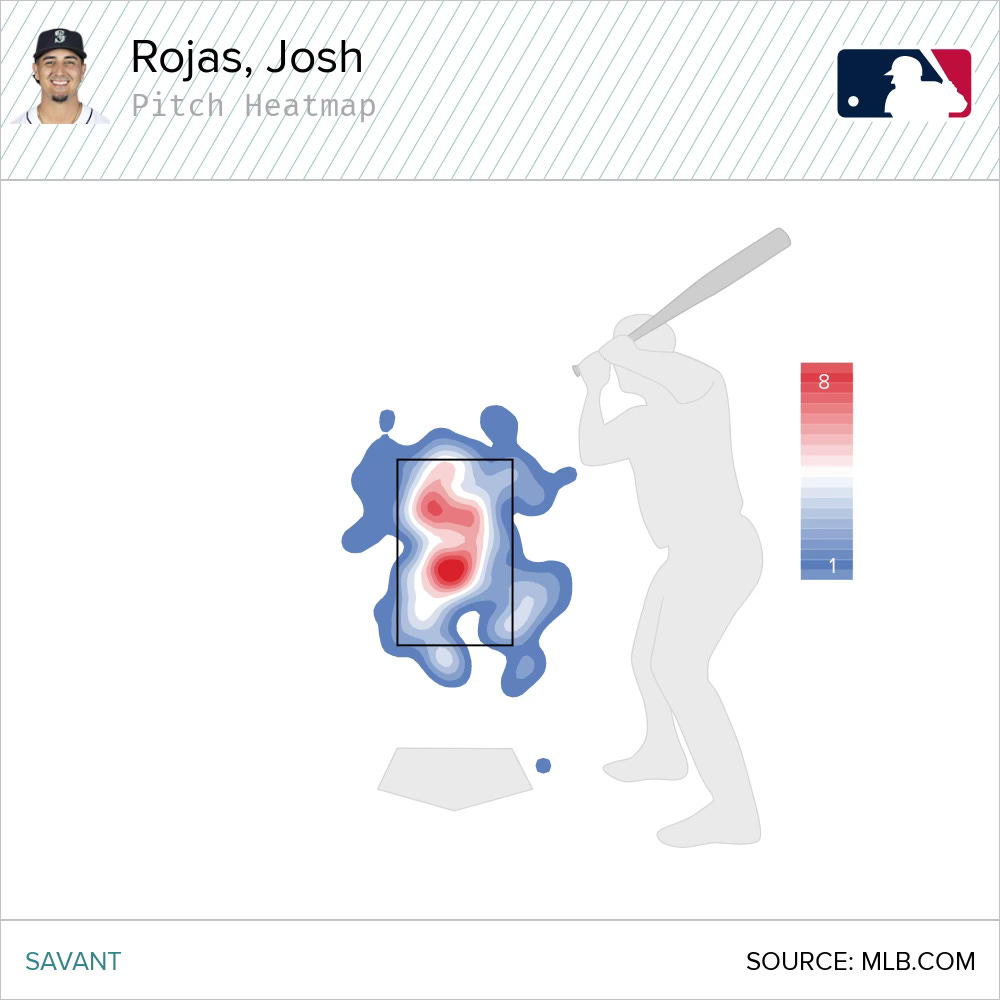
And because he’s now fully committed to hunting the easiest pitches to hit, his quality of contact numbers have soared.2 He has a .419 xwOBAcon on the back of a 50% sweet spot rate and a career high 32% line drive rate. He’s not necessarily scorching the ball every time, but he’s elevating and giving his batted balls a chance to find grass.
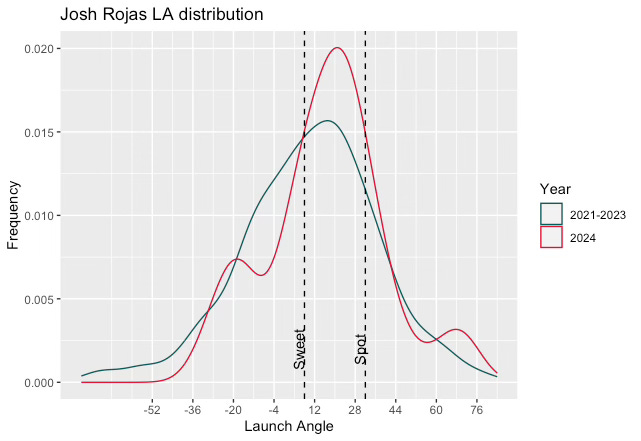
Now, Rojas’ numbers might be a bit inflated. He’s probably not going to run a .368 BABIP all year, and his .396 overachieves his .378 xwOBA a bit. He’s also had similar hot stretches in the past before returning to a reliably average performance. But it’s encouraging that he’s not just trying to put the ball in play anymore—he’s hunting drivable pitches and making legitimately good contact. We’ll see how that holds up into May as the league begins to adjust.
Urías’ production has come in a different way. He ranks in the bottom 10% by the heart swing index and has chased about half the pitches he’s seen out of the heart region. He’s also whiffing about 30% of the time and has a nearly 40% strikeout rate. But exactly half of his batted balls have been hard hit, and he’s running a 62.5% sweet spot rate. His .445 xwOBAcon ranks in the top 15% of the league, and all five of his hits this year have been for extra bases.
On the one hand, this is a bit concerning. Urías probably can’t sustain great contact with a bad approach. On the other, his approach in prior seasons has been very good, and the quality of contact has been what’s missing from his profile until now. Perhaps this is a sign that he’s found a bit of power, and the approach will return with reps. His swing decisions also aren’t as bad as they seem. He’s not wildly chasing way out of the zone—he’s simply swinging at too many shadow pitches and watching too many heart pitches. Looking at game-level samples, his swing decisions have been a mix of great games and terrible games, rather than just consistently looking bad.
So it seems more like a consistency thing to me. He’s just not fully locked into his approach quite yet.3 Urías admitted on Thursday that the platoon role has been a bit of an adjustment.
“It’s been hard,” he said. “I’ve never been in this spot before. But it’s not about me, it’s about the team. I show up trying to stay positive, trying to go through my routine. Even if I’m not in the lineup. I know I can get into the game in the seventh or eighth. So I just try to stay ready.”
The other element, of course, is defense. Rojas has historically been bad at third by all metrics. Urías is more mixed, with DRS and UZR looking favorably on his play there and OAA being more neutral. But Urías also showed up to Spring Training with an injured arm, and there are ongoing concerns about his ability to make the long throw across the infield.
Both players fed into those concerns in the first series with a few mental errors. But they’ve picked it up since and now look perfectly adequate. I don’t think they’ll fully replace Geno’s elite defense, but continuing to provide zero OAA would be just fine.
“Just like with your offense, defensively you have to get some confidence going,” Rojas said last week. “There’s a ton of new plays that you have to make in games. You can practice ground balls all you want, but the game situation is a whole lot different. Especially with us platooning, it’s not like we’re in there every day, so you’ve just got to get your feet under you and build that confidence.”
Something to watch going forward is whether the Mariners can maintain fidelity to the platoon. One reason it’s worked so far is the near flawless implementation.
Urías has a relatively large platoon split for his career. The Mariners have done well to limit his exposure to same-handedness pitchers—66% of his plate appearances this year have been against lefties (compared to just 24% for his career). Rojas doesn’t have significant career platoon splits, but more than 90% of his plate appearances this year have come against righties.
It’s unclear how long the Mariners can continue to shield them from unfavorable matchups. Even if both stay healthy and good, others won’t, and the platoon will likely be fractured at times to cover elsewhere.
Bonus: Mariners offense shows best performance in MLB
Rojas wasn’t the only Mariners batter to have a great day on Friday.
I generally talk about the same four things with batters:
What pitches do they swing at;
How often do they make contact;
How hard do they hit the ball; and
At what angles do they hit the ball.
To evaluate the first, I use the heart swing index, which is a ratio of heart swings as a percentage of total swings and relative to the number of heart pitches seen. With the second, I look at the rate of heart swings converted to balls in play. With the third, I look at harder hit rate, which is batted balls greater than 100 mph. And with the fourth, I use an exit velocity neutral xwOBA that assigns the league average wOBA for each launch angle.
I typically look at these independently to paint a broader picture of a player’s strengths and weaknesses beyond the standard results and x-results.
Recently, I’ve been playing around with a way of capturing all of these in one number that I’m calling the Dipoto Coefficient.4 My method is simply to take the z-score of each metric and add them all together into one big score.
The Mariners offense on Friday ranked in the top 5% of all team games in MLB in each of the four metrics alone. Added together, their total Dipoto Coefficient ranked first, making it perhaps the best team game in MLB this year by these underlying metrics.
On the full season, the Mariners now rank seventh in the aggregated measure. They are fifth in swing decisions, seventh in harder hit rate, 14th in launch angle quality, and 20th in heart BIP rate.
--
The Mariners also have 0.7 fWAR at catcher, although that ranks 11th in MLB right now.
It feels like I’ve written this in articles a dozen times about a dozen players the last few years, but it never gets old seeing a batter properly implement this approach and get results.
Urías is on the short end of the platoon and has all of 33 plate appearances, after all.