Game 42 - First look at bat speed
Julio swings fast.
We could already infer that because Julio hits the ball hard. But we now know for sure after Baseball Savant released its bat tracking dashboard on Monday. The two primary additions are bat speed and swing length, which Savant has packaged into a variety of other tools.
Julio has the ninth fastest bat speed in MLB at 76.2 mph on average. He swings harder than 75 mph about 65% of the time. His fastest swing this year was 87.8 mph and resulted in a foul ball. His slowest (checked) swing was 15.9 mph and also resulted in a foul ball.
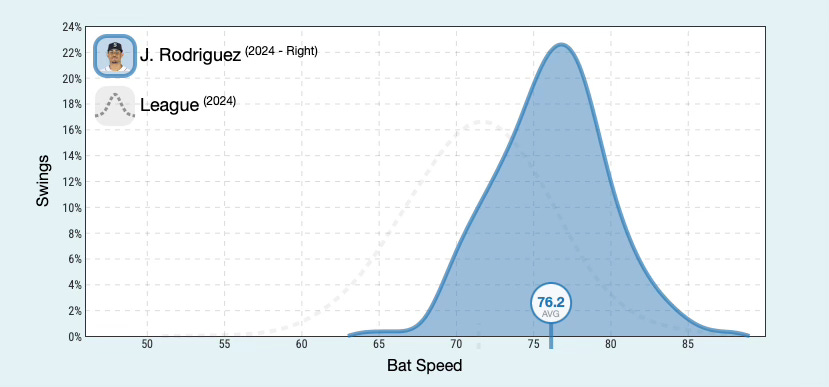
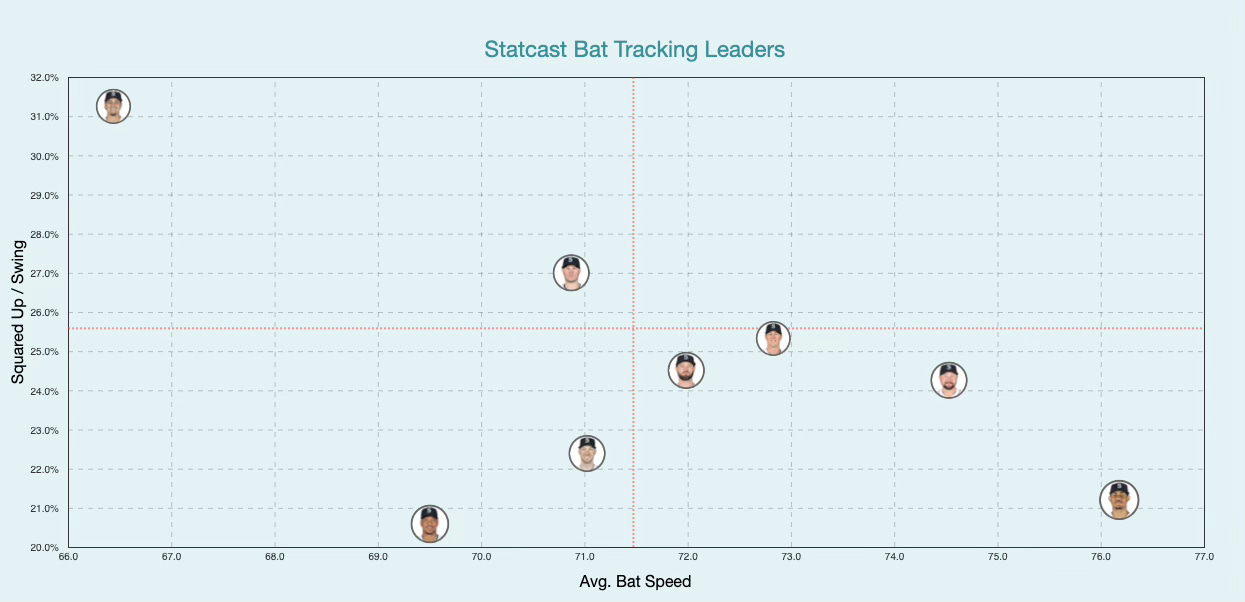
Mitch Garver has a roughly average bat speed at 71 mph. That’s notable because people (including myself) have speculated that his swing is slower now as a way to explain his early struggles.1 We can’t know for sure, however, as the data only includes bat speed for 2024. One other note is that Garver’s fast swing rate (>= 75 mph) is about 10%, which is bottom third of the league. I’m not sure how much that matters.
Ty France also has a roughly average bat speed of 70.9 mph. France, of course, spent the offseason in his underwear at Driveline “retooling” his swing. Again, we have no baseline for comparison, but we know that Driveline did not turn him into Giancarlo Stanton.
The slowest swing on the team belongs to none other than Josh Rojas at 66.4 mph. In fact, Rojas has the seventh slowest average bat speed in MLB. What Rojas does well, though, is square up the ball. To count as “squared up,” a batter must impart an exit velocity of at least 80% of the possible exit velocity based on the swing speed. This is a way to capture the quality of the literal bat-to-ball contact—i.e., did the batter get the barrel on the ball. Rojas has squared up about 37% of his contact, which is the most on the Mariners and in the top quarter of MLB.
Cal Raleigh swings hard—he has an average bat speed of 74.4 mph. He swings 75.1 mph from the left side of the plate and 72.8 mph from the right side of the plate.
Sam Haggerty has a more severe split. He has an average bat speed of 67.8 mph from the right side and 58.9 mph from the left side. Tom Tango had an interesting post recently that highlighted Haggerty as a switch hitter with a slower swing and worse performance from one side of the plate. Perhaps this framework will allow us to identify the “true” switch hitters going forward.
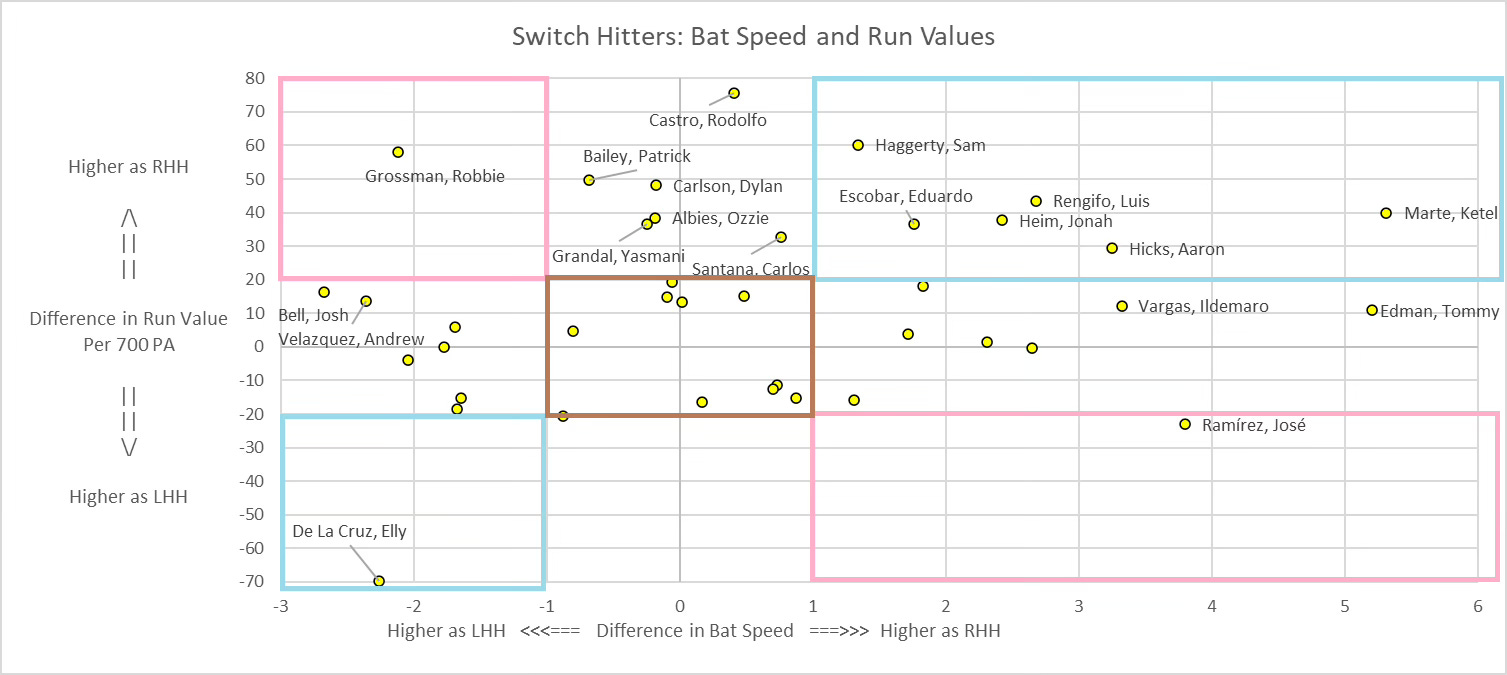
(Notice Robbie Grossman in the upper left as someone with a slower swing speed but better performance from the right side. Interesting.)
This new data inspires plenty of new questions. Who has the most variance in their bat speed? Does bat speed slump? Does bat speed drop over the course of a season? Who swings the hardest at pitches out of the zone versus pitches in the zone? Does pitch type/velocity affect bat speed? Can bat speed be used to find injuries? Does bat speed affect launch angle?
One thing I haven’t looked into much yet is swing length. Longer swings apparently lead to higher whiff rate and more power. As I wrote yesterday, the Mariners seem to hit the ball hard but struggle to make contact. Are the Mariners making the right swing for the situation? Are they swinging hard at early heart fastballs? Are they swinging more carefully with two strikes? What’s the tradeoff? Does it even work like that? Perhaps this will be the first topic to explore in depth.
Mike Petriello in his article suggests this is just the beginning.
What’s not here? It’s important to note that what’s currently displayed is merely the first wave of a number of data points. For example, who swings with the steepest attack angle? Which pitcher misses bats by the most distance? Who is the earliest or latest on their swings? Who’s making contact out front, or not? Those, and several other ideas, are in the future pipeline
Exciting times.
--
Tom Tango reported that bat speed declines with age