Game 51 - Notes on the Yankees, the offense, and a trade
The Yankees are fine.
Aaron Judge is cool, Giancarlo Stanton swings very hard, and all those other clean-shaven fellas seem alright. I appreciate the team’s history, the success, and the cultural relevance.
But watching four consecutive games at Yankee Stadium, even on TV, is a miserable experience. The stadium is tacky. The dimensions are Mickey Mouse. The incessant audio effects should be illegal. And every 10 seconds the camera cuts to a guy in a barrister wig, or Jimmy Fallon, or some other scoundrel you hope to never see again.
I’m glad the Mariners have played their final game in New York, at least for the regular season.
Lineup shuffle
The offense was bad on Thursday.
It was so bad, in fact, that Dave Sims called the seven-pitch top of the fifth “a cotton candy inning.” The Mariners recorded just three hits, struck out at 12 times, and posted a .138 xBA. By Core Score, it was their worst performance of the year, and a bottom-10 team performance in MLB.
Despite Thursday, the offense has been OK of late. Here’s a look at the Mariners rolling wOBA averaged over 250 plate appearances.
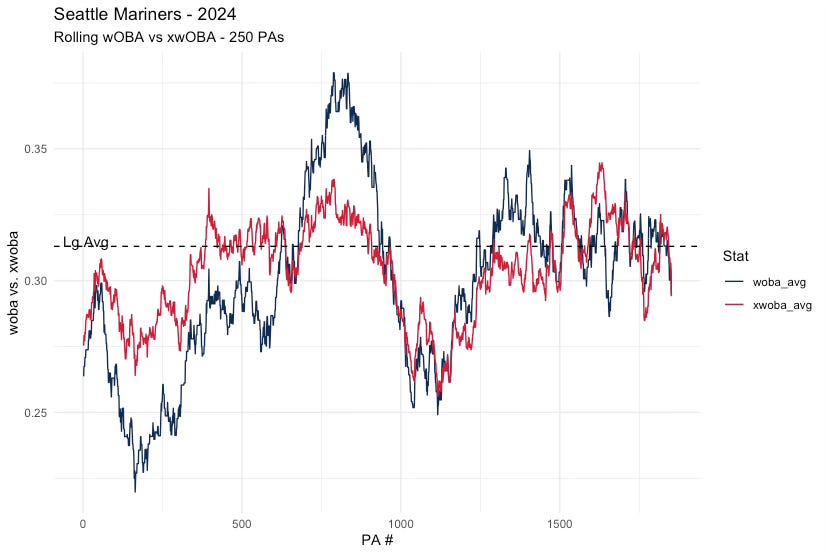
The question I try to address with these charts is, “How good are the Mariners right now?” We could look at their full-season numbers (98 wRC+), but that doesn’t tell us much about recent trends. We could could look at monthly or weekly splits, but those are just arbitrary cutoffs.
The rolling average works because we can see not only how good the Mariners have been over their most recent X plate appearances, but also how good they’ve been over any X plate appearances. And from that, we can infer trends.
What the rolling average doesn’t do, however, is give us a way to contextualize those trends. It’s hard to tell how much to value the early slump versus the middle spike versus the current hovering near average. And how do those trends compare to the rest of the league?
That’s where I’m exploring an exponentially weighted rolling average. This approach gives some weight to every game on the season, with the most recent games getting more weight. It allows us to capture each trend by proximity to the present.
Since the results don’t fully look like wOBA, and since everything in baseball is relative, I like to present this as a daily ranking.
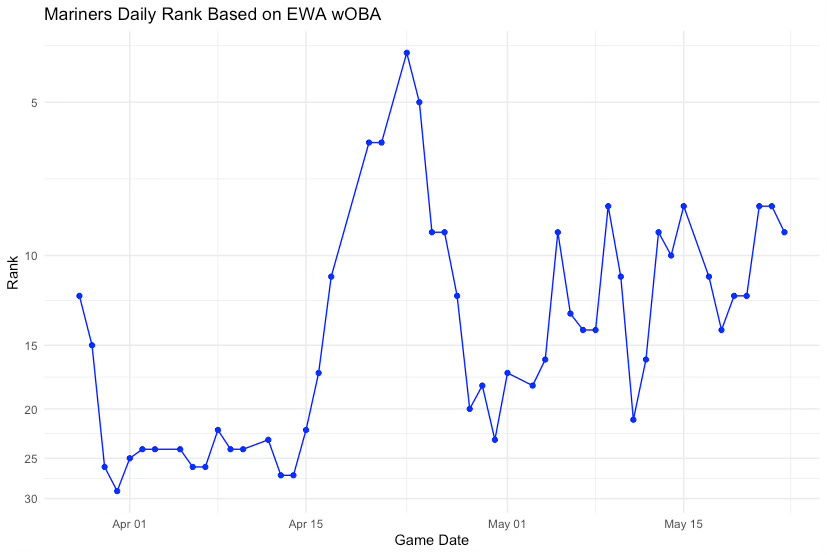
The Mariners offense currently ranks ninth in MLB.1 That’s pretty good. If you want to infer some park adjustment, you could claim them higher.
“How” the Mariners have got to ninth hasn’t changed since my last State of the Offense. They still swing at good pitches, make good contact, but struggle to put the ball in play. What’s changed is the “who.”
Here’s the Mariners CoreScore leaderboard since May 1.
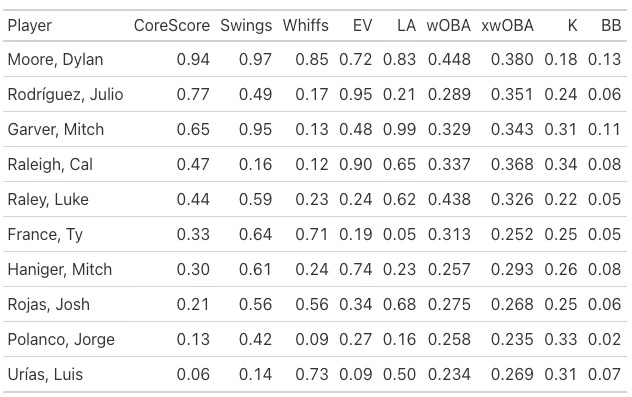
(CoreScore and its components are listed as percentiles. wOBA, xwOBA, strikeout-rate and walk-rate are listed as standard percentages. ‘Swings’ is short for swing decisions. ‘LA’ is short for sweet spot rate.)
Both Dylan Moore and Luke Raley have been great since getting regular playing time, although both seem to have benefited from a bit of batted ball luck.
Mitch Garver has turned it around and looks good overall. The whiffs and strikeouts remain discouraging, but the excellent swing decisions and top 1% sweet spot rate suggest he’s found something familiar.
Cal Raleigh is still Cal Raleigh.
And hey look, there’s Julio with a .351 xwOBA in the month of May. I’ve been putting off writing about Julio because 1) I assume he will figure it out any day now, and 2) his problem is obvious and well documented—he either whiffs or crushes the ball directly into the ground. Still, maybe he’s not struggling nearly as bad as the results indicate.
Josh Rojas has disappeared. I wrote earlier this month about possible regression for Rojas, which appears to have happened. But it hasn’t come in the form of reduced batted ball luck—his peripherals have completely bottomed out. This could be a cautionary tale for Moore and Raley. It’s easy to look at wOBA versus xwOBA and assume xwOBA is the baseline where results will return. But peripherals can spike, too, and hot streaks aren’t just a matter of BABIP. Sometimes players are just seeing the ball well, and sometimes that coincides with a bit of good fortune. That’s why I like to look at CoreScore and its components.
The Mariners have four guys hitting well right now plus Julio. I imagine at some point things will shift again. Moore and Raley will return to Earth, and maybe Ty France or Mitch Haniger or Dom Canzone or J.P. Crawford will pick up in their place.
Scott Servais said earlier this week that the lineup will feature “who’s going best.”
“We're trying to give our team the best chance to win every night,” Servais said. “It's going to be a different lineup. It's going to change here probably on a nightly basis.”
We saw that on Thursday with Moore and Raley moving up in the lineup.
One thing I like about the Mariners roster is it’s flexible enough to allow them to capture the hot streak of any combination of players. As long Servais continues to stay on top of “who’s going best,” I think the offense will continue to play above average.
Trade!
Mike Baumann made his Mariners debut on Thursday, although he did not pitch particularly well. He was acquired this week in a trade with the Orioles after being designated for assignment
Baumann hasn’t been great to this point in his career with a 4.44 FIP, 19% strikeout rate, and 11% walk rate in 127 innings. He does, however, have an interesting fastball and a few decent offspeed pitches. I wrote the other day about how the Mariners have a few gaps in their bullpen, and it seems like they’re exploring new/better/different options (they also shuffled some minor league relievers on Thursday afternoon). We’ll see what the Mariners pitching lab can make of Baumann.
The Mariners sent minor league catcher Blake Hunt to Baltimore in return. I’ve seen some disappointment online about losing Hunt, who was having a decent year in Tacoma before the trade. Baseball Savant now gives us some minor league data, which shows that he’s outpaced his expected wOBA on contact by almost 100 points. He has a below average hard hit rate, below average launch, and below average swing decisions. He seems like a glove-first backup catcher, which works out since the Mariners also got in the deal glove-first backup catcher Michael Pérez.
--
This chart gives 10% of the weight to the most recent game, with the other 50 games splitting 90% of the weight in descending order. Is that the correct weight? I have absolutely no idea. A standard average would give each game an equal weight of about 2%, since there’s been 51 games. So with this, we’re saying the most recent game is worth five times the average game in describing the current state of the offense. I’m sure there’s an objective way to test this for both teams and players. We’ll get there at some point.