Game 64 - Exploring a DH penalty for Mitch Garver
There might be something to the DH penalty for Mitch Garver, but it’s not entirely clear.
Garver played catcher on Tuesday for the second time in 2024. Scott Servais said last week that Garver will play there sometimes to “free him up.”
“Just trying to do some things to get him going a little bit,” Servais said. “He’s never been a full-time DH at any point in his career.”
“This is not a situation where he’s going to go back and catch three or four days a week,” Servais said. “… We’ll see how it goes. Again, I don’t know what it’s going to look like. We don’t have big expectation one way or another. Just kind of take a game at a time.”
I have some thoughts about Garver (I think he’s fine), and I have some thoughts about this decision specifically (I think it’s fine). But what I want to discuss today is the idea that Garver, as Servais implies, might need time off from DHing.
A hitter, by design
Whether there’s a specific skill required to play DH is a topic that comes up every so often.
The Ringer in March published a feature article on declining production at the position. Their takeaway is that teams tend to use the position as a rotating off day for “volume management.” Teams do this mainly because they prioritize flexibility, but also because there just aren’t that many DHs good enough to play full time.
Why?
Well, the article points to research from Russell Carleton at BP that seems to imply there is a real, observable DH penalty—it’s not as simple as sticking a batter there and expecting them to hit. However, Carleton also notes the DH penalty seems to go away with playing time, which implies there is a learned skill at the position.(#footnote-1)
The Ringer article details a number of ways playing DH might affect player performance. But the most interesting anecdote I found comes from Bryce Harper and Andrew McCutchen.
Both Harper and McCutchen say the idea of DH games as semi-off days is something of a misconception that may stem from the perception of DHing as a part-time gig. From a physiological perspective, DHing provides real rest and a means of accommodating injury limitations. But to do the job to the best of their abilities, Harper and McCutchen had to reappraise it as worthy of their full attention.
“When you’re not doing it [full time], it’s kind of like, ‘Oh, I’m just taking four at-bats, how hard could this be?’” Harper says. However, he adds, “When you’re doing it every day, I don’t feel like it’s too much of an off day.” Put another way: When he stopped thinking of DHing as a break from something else, Harper’s performance as a DH skyrocketed.
“I kind of looked at it like a half day off,” McCutchen said about the time in his career when he DHed infrequently. “I’ve learned that you can’t do that. That’s hard to do. Because you can’t mentally be into something halfway and think you’re going to succeed. Maybe there’s some guys out there who can do that, but for me personally, I couldn’t.”
I bring this up because this was all in the background when the Mariners first announced the Garver signing.
The Mariners made it very clear they planned to make Garver a (mostly) permanent DH in an attempt to keep him healthy. Garver seemed optimistic about the plan overall, but he expressed some awareness of the unique challenge of the position.
“It’s not an easy position,” Garver told The Seattle Times. “I’ve learned a lot over the years, basically here and there. But when I got into a consistent routine on how to do it, I became a little bit better at it.”
Searching for a DH penalty
Garver for his career has been worse at DH. He has a .307 career wOBA at DH in 625 plate appearances; he has a .365 career wOBA at catcher in 1,115 plate appearances.
Case closed? Not exactly.
In attempt to measure this empirically, I filtered the data to include only games from 2022 and 2023.(#footnote-2) I also only included games where Garver started the game, had at least four plate appearances, and played exclusively catcher or DH. Here are his splits by position under those conditions:
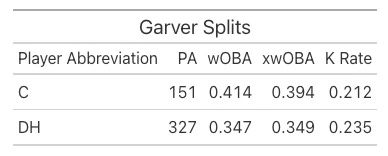
Case closed? Again, not exactly.
In my first series of regressions, I grouped observations by game. The plot below shows game-level wOBA on the x-axis, with the relative frequency on the y-axis. Garver’s games at DH are clustered around the lower (worse) values, while his games at catcher tail towards the higher (better) values.
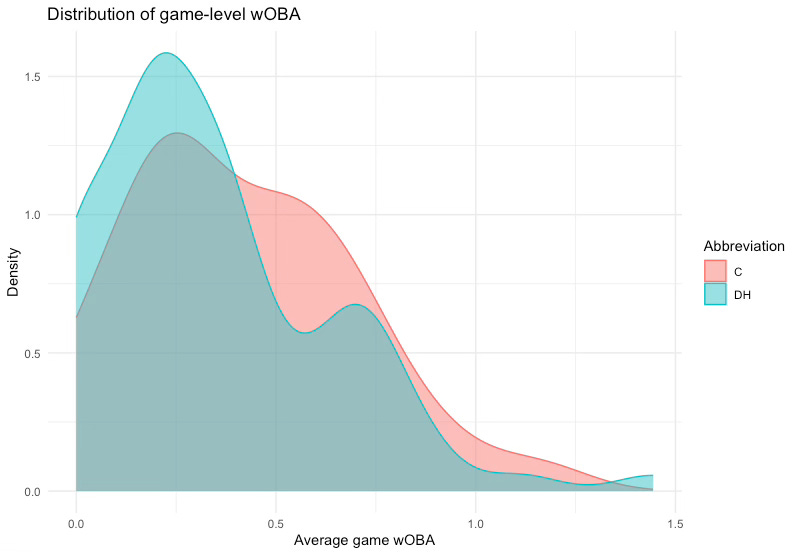
(35 catcher games; 76 DH games)
The simplest regression model, where wOBA is a function of position alone, doesn’t show a statistically significant relationship. I added several of covariates, including the year, the month, the venue, the game time, etc., but I did not find anything to suggest Garver’s position directly affected his performance.
The reason comes through when looking at this plot—the range of values is large and varied at either position.
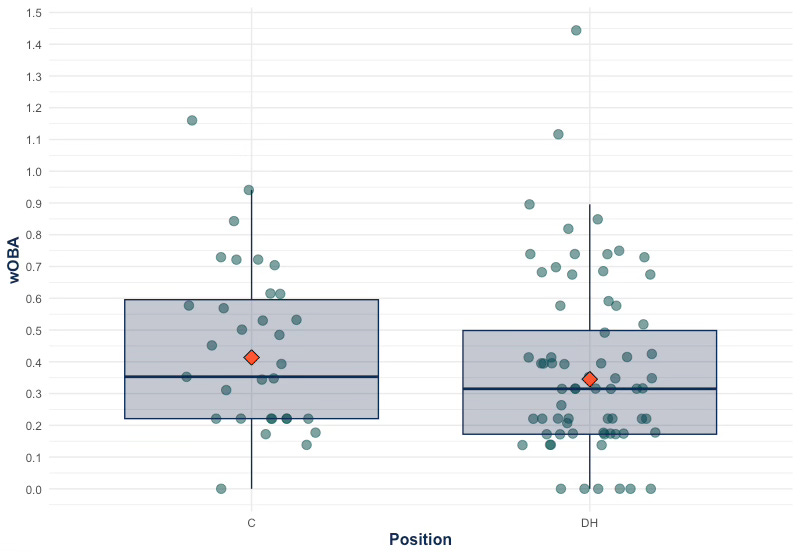
One important factor that’s omitted when looking at game-level data is pitcher handedness. Garver is about 20% better in his career against lefties than against righties. This matters because about 36% of his PAs as a catcher came against lefties, while only about 22% of his PAs as a DH came against lefties.
In a second series of regressions, I looked at the individual plate appearance level and controlled for pitcher handedness. But again, I found no statistically significant relationship between position and performance, even when controlling for the year, month, venue, etc.
Paralysis by analysis
Something else Servais said last week about Garver got me thinking.
“I think you feel like oftentimes you don’t really connect to the game,” Servais said of playing DH. “And you also have too much time to maybe think about your hitting and your at-bats.”
Maybe the DH penalty is less of a direct effect and more of a compounding of errors. Maybe players tend to over analyze between at bats, especially when the pitcher gets the best of them early.
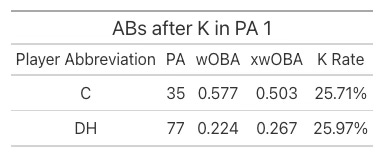
So let’s just look at games where Garver struck out in his first at bat. Here are those splits:
And here are the splits when he didn’t strikeout in the first at bat:
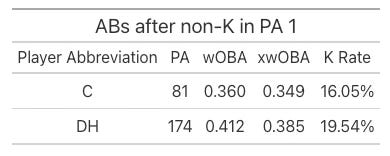
That’s massive. When Garver struck out in his first at bat as a catcher, he was still good the rest of the game. When Garver struck out in his first at bat as a DH, he was terrible the rest of the game.
But again, the statistical significance of the relationship is weak—the sample is small and the variance is high.
Mixed results
I do think there’s something here, though.
The basic summary statistics are damning on their own. And I never ran a test that showed DH as anything but a large, negative value relative to catcher. The issue is a matter of causal inference. There isn’t enough evidence to confidently say that Garver’s position alone directly affects his performance, but that doesn’t mean the relationship doesn’t exist.
Simple linear regression also isn’t the appropriate tool for this type of data—the distribution of wOBA is bound on either end and clustered toward zero. There are other types of models better equipped to handle this issue, and there are potentially better outcome variables that could be used in place of wOBA. It’s possible a more thorough analysis would find a causal link, especially given Carleton’s broader discovery about a DH penalty.
On the other hand, my base assumption coming into this was that there’s likely something else about the days Garver played DH that affected his performance, and that something else just happened to coincide with playing DH (or maybe even caused him to play DH). Again, he was far more likely to see righties as a DH, which might imply something about the construction of the Ranger’s roster itself—i.e., he was the best of several bad options to DH against a certain pitcher. Or maybe it’s as simple as he was on a hot streak when the Ranger’s roster situation required him to catch, and he wasn’t nearly as hot when the Ranger’s roster required him to DH.
The data is clear that Garver was worse when he played DH the last two seasons. But was he worse because he was played DH? I don’t know.
Postscript
Look, I still like Garver. I liked the decision to bring him in as a full time DH, and I don’t necessarily think the Mariners need to abandon that now. If the Mariners want to make him a backup-catcher-DH hybrid, or if that’s the role Garver is asking to return to, I think that’s fine. Regardless of his early performance, I’m fairly confident in Garver going forward.
What I don’t like is Garver as a quasi-backup catcher for seven innings while the true backup sits on the bench unused. If the Mariners are going to continue exploring Garver’s viability at catcher, I think they need to commit soon—either by going out and getting a true backup they trust, or by finding a rotation where Garver can catch and DH and everyone is healthy and good and confident.
--
Note that I did not read Carleton’s work because I am paywalled—this is just a summary of the interpretation by The Ringer.
Garver had 60 total plate appearances at DH in five seasons prior to 2022. There might be some valuable information in there, but it’s hard to separate the DH effect from the reasoning to play him there on those specific occassions.