The perpetual projection
We’ve reached the end of the circle.
On Opening Day, the Mariners were projected to win 86 games. It didn’t seem like enough to win the AL West, and it wasn’t. They aimed low and missed.
Jerry Dipoto called the season “incredibly frustrating” in an end-of-season media scrum. He offered a vote of confidence in the core roster—"I think this group is the right mix"—but acknowledged there’s work to be done.
“We’re just having a tough time figuring out how to climb that wall from a ‘good’ team to a ‘very good’ team, or a ‘great’ team,” Dipoto told Kate Preusser at Lookout Landing.
“I could look at the teams that are in (the playoffs), and we believe we’re as good or better than those teams, and in some ways we perform better than those teams. … We have to find a way, over the course of a six-month season, to be more consistent. This year is a great example. We’ve shown high-highs and low-lows, and we have to figure out how to create more of an even performance across a six-month season.”
The offseason will be awkward. Players, personnel, and broadcasters will leave. The media will speculate. I have thoughts, but for now I’ll just say that winning cures most. A lot can change in a year.
Here’s some stray numbers and graphs for the end of the season.
Luck
The Mariners official record was 85-77, but they were a bit unlucky. Their expected win total was 89 by pythag and 90 by BaseRuns.
Here is their run differential throughout the season:
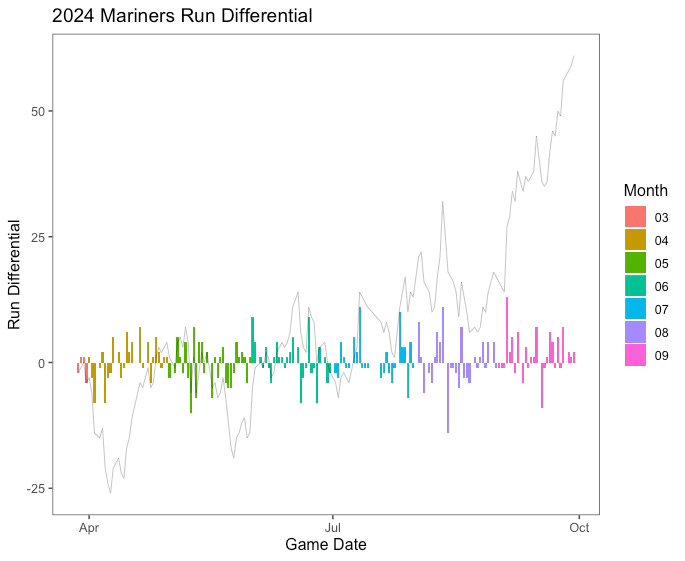
The Mariners were a roughly 86-win team by pythag when they held a 10-game lead over the Astros in June; they were a roughly 83-win team when they fell to .500 in August; and then they were an 89-win team by seasons end.
Now, pythag might not perfectly capture run distribution. The Mariners were 24-16 with a +62 run differential in games decided by five-plus runs. I’m not sure how much this matters, and that’s a project I have planned for this winter.
The Edgar offense
This will also get its own post eventually, but I want to show the final rolling wOBA for the season. Every point here reflects the previous 1000 plate appearances for Mariners batters. The vertical line shows where Dan Wilson and Edgar took over.
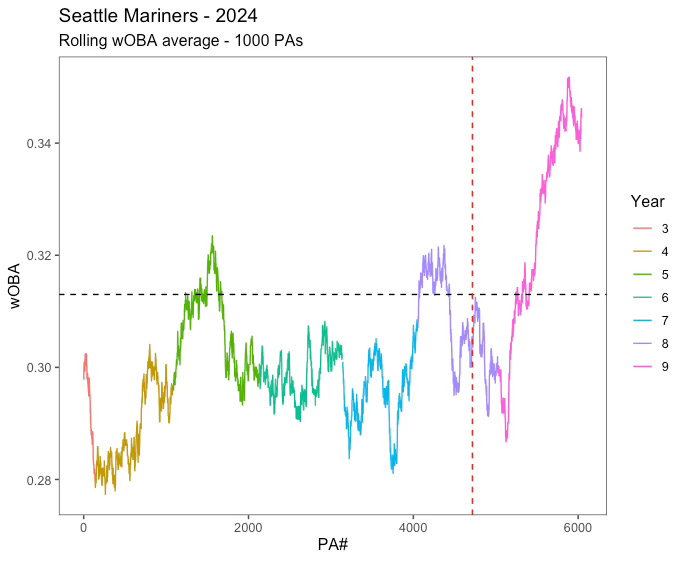
Note: The version of this graph originally published showed xwOBA not wOBA. This version shows wOBA.
Maybe there’s something to the narrative that Edgar’s wisdom changed the trajectory of the Mariners offense. But it’s worth noting that the Mariners had a similarly-timed (and greater) leap in 2023 under Scott Servais and Jarret DeHart.
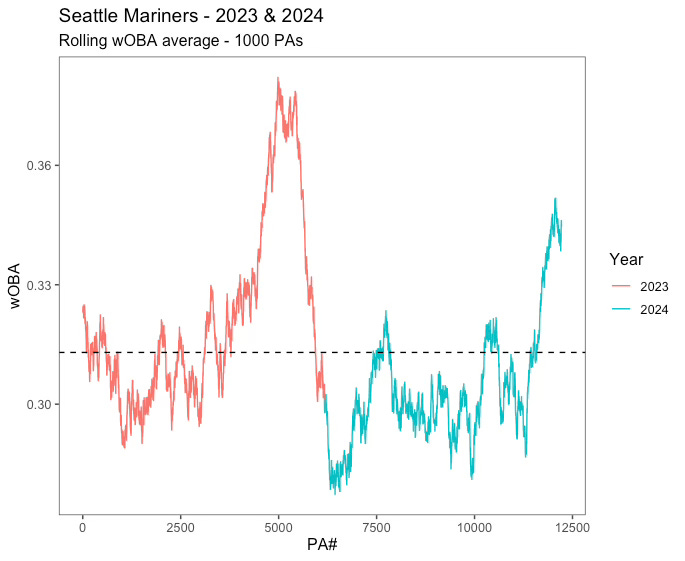
Note: The version of this graph originally published showed xwOBA not wOBA. This version shows wOBA.
There’s also some interesting stuff going on with xwOBA. The Mariners will generally underperform their quality of contact because Seattle’s marine layer cuts carry distance. But I think there’s something instructive in how that xwOBA discrepancy was distributed throughout the season.
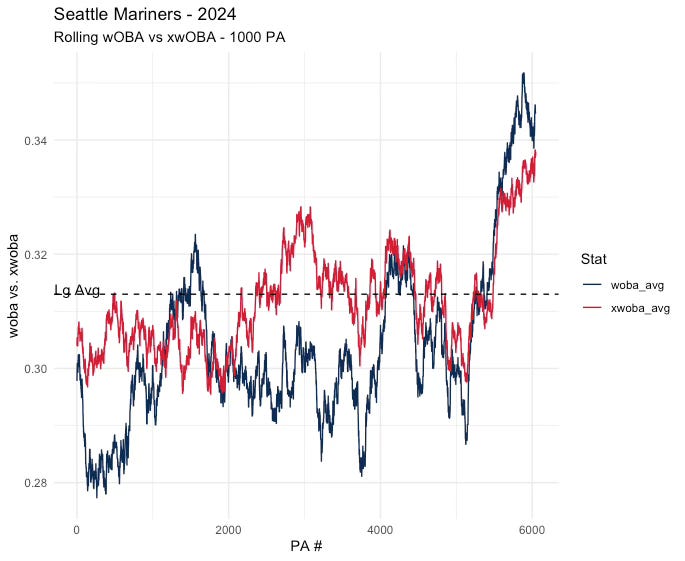
Mariners batters performed about average for a large portion of the summer, but their results lagged behind by about 20 points of wOBA. They did outperform their expected results at times as well—and by seasons end they weren’t an outlier—but those missing results happened to coincide with the collapse.
Game Score
The Mariners rotation was very good this year. They finished fourth in MLB by fWAR and third by FIP. In team history, the 2024 rotation ranks eighth by fWAR and first by FIP.
My favorite pitching metric remains Game Score—specifically, Tom Tango’s version. It’s probably more of a “fun” metric than an empirical measure of value. But there’s still rigorous statistics involved, and I think it best captures the goal of a starting pitcher.
The 2024 Mariners finished with an average game score of 55, which is tied for sixth in the pitch tracking era (the 2011 Phillies remain the undisputed champions by this metric). Here’s the Mariners game score rolled over 15 starts (or three turns through the rotation):
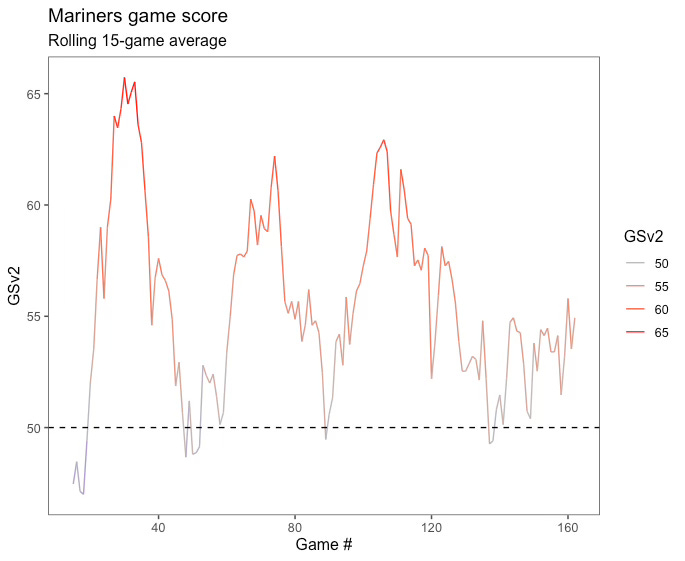
They were not nearly as excellent for the final quarter of the season, but it was a remarkable 162 games for the rotation nonetheless.
My favorite tool on Baseball Savant is Tango’s rolling game score ranking. It rolls game score over the last three years and gives more weight to recent starts. The result is a statistically-vetted-barstool-ranking of the best pitchers in MLB on any given day.
The Mariners finish the season with these rankings:
Logan Gilbert - 9th
George Kirby - 18th
Bryce Miller - 19th
Luis Castillo - 24th
Bryan Woo - 40th
If there are 150 rotation spots in MLB, and if you think of rotations in the normative one-two-three-four-five system, you’d probably say there are 30 “number one” pitchers in MLB at any given time. The Mariners, by this method, finished the season with four number one pitchers.
It’s also worth noting that Gilbert ranked as high as third in MLB at one point this summer. I wrote a few years ago about how the Mariners staff lacked a true ace. That is no longer true.
Crucial plays
Win Probability Added (WPA) tells us how much a given play changes the odds of winning a game. A grand slam down three in the bottom of the ninth is worth a lot of WPA.
Baseball Reference takes this a step further with cWPA (the “c” stands for championship). It shows how much a given play changes the probability of winning a game and layers in how much that game impacts a team’s chances to win the World Series. A go-ahead homer in game seven of the World Series is worth a lot of cWPA.
This is something I like to follow every year. It provides some context for the most crucial plays of a season. Here’s a link for the top cWPA plays for the 2024 Mariners.
The most important play of the year was Mitch Haniger’s bases-clearing double in August to walkoff the Tigers. The next most important play of the year was Mitch Garver’s walkoff home run against the Braves way back in April.
The largest negative swing of the year was an extra inning walkoff home run off Austin Voth in July.
The largest negative swing on offense is technically a three-way tie. I give the nod, however, to the nightmare strikeout-pickoff-TOOTBLAN composed by Randy Arozarena and Julio. It was the worst thing I saw from the Mariners this season, and it happened to matter a bit, too.
--